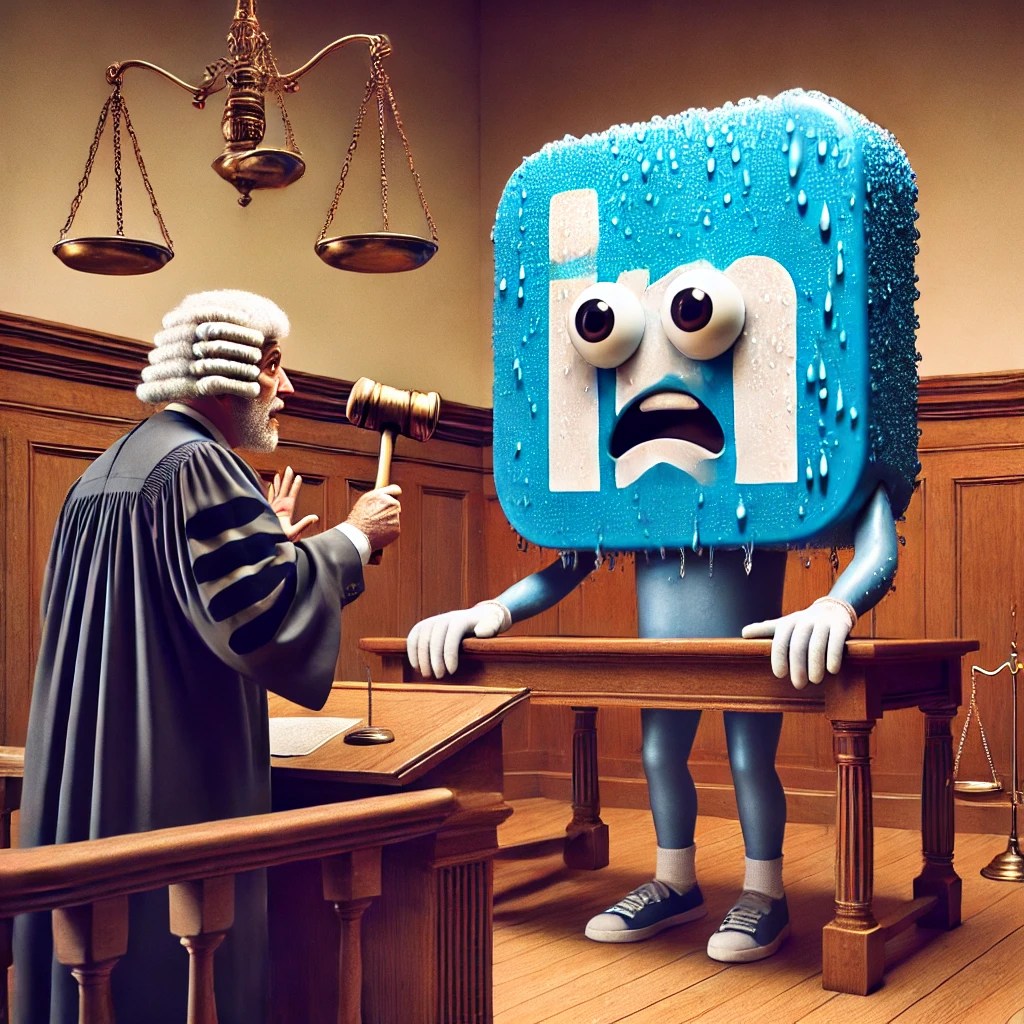
IN THE GLOBAL JURISDICTION FOR THE INTERNET
The people of the free world, on behalf of themselves and all others similarly situated,
Plaintiffs,
v.
LINKEDIN CORPORATION,
Defendant.
CLASS ACTION COMPLAINT
I. INTRODUCTION
- This class action lawsuit is brought against LinkedIn Corporation (“LinkedIn”) for engaging in arbitrary and capricious account suspensions and bans, while selectively permitting hate-filled and violent content to remain on its platform. These practices have harmed thousands of users, particularly those who rely on LinkedIn for their professional livelihoods.
- LinkedIn is the dominant business networking platform, functioning as a de facto monopoly in the professional social media industry. Its arbitrary enforcement of content moderation policies severely impacts individuals’ careers, income, and opportunities, disproportionately harming underprivileged and marginalized communities.
- Plaintiffs seek injunctive relief, damages, and any other relief the Court deems just and proper to prevent LinkedIn from continuing its unjust, secretive, and biased content moderation practices.
II. JURISDICTION AND VENUE
- This Court has jurisdiction pursuant to 28 U.S.C. § 1332(d) (Class Action Fairness Act), as the matter in controversy exceeds $5,000,000 and involves plaintiffs from multiple states.
- Venue is proper under 28 U.S.C. § 1391 because LinkedIn conducts business nationwide, and many affected class members reside within this District.
III. PARTIES
- Plaintiffs are professionals, entrepreneurs, and job seekers who have had their accounts suspended or banned by LinkedIn without meaningful explanation, appeal process, or justification.
- Defendant LinkedIn Corporation is a Delaware corporation headquartered in Sunnyvale, California, and is a wholly owned subsidiary of Microsoft Corporation.
IV. FACTUAL ALLEGATIONS
LinkedIn’s Terms of Service are invalid and unenforceable because users have no meaningful ability to negotiate them, and the only way to access the network is to accept them. Virtually no users read these terms, and LinkedIn retains the unilateral right to change them at any time without meaningful notice. Additionally, these terms are inconsistently applied, with some users facing strict enforcement while others are permitted to violate policies without consequence.
Moreover, LinkedIn functions not just as a professional networking platform but as a sophisticated surveillance network. Evidence suggests that insiders have access to and actively monitor users’ direct messages, which individuals reasonably assumed to be private. This covert surveillance undermines trust and raises serious privacy and ethical concerns, as sensitive business and personal communications are exposed to unauthorized scrutiny.
Evidence supporting these allegations includes thousands of screenshots and videos captured by both impacted and unimpaired users over the last few years, documenting instances of arbitrary enforcement, shadow-banning, manipulated reach, and selective content boosting.
A. LinkedIn’s De Facto Monopoly
- LinkedIn operates as the only significant business-focused social networking platform, controlling the majority of the professional networking market.
- Given its market dominance, LinkedIn’s arbitrary and secretive enforcement practices are not merely an inconvenience; they directly impact individuals’ professional opportunities, employability, and financial stability.
- Professionals, recruiters, and businesses depend on LinkedIn for career advancement, lead generation, and networking, making the platform an essential service for professional success.
B. Arbitrary and Capricious Account Suspensions and Bans
- LinkedIn employs an opaque, black-box algorithm to moderate content and user accounts, resulting in inconsistent and unjust enforcement.
- Plaintiffs and class members have been suspended or permanently banned without clear explanations, while other users posting overtly violent or genocidal rhetoric remain active.
- Many impacted users rely on LinkedIn as their primary means of generating income, securing employment, and maintaining professional relationships, and such unjustified bans disproportionately harm those who are economically vulnerable.
C. Disparate Impact on Underprivileged Users
- Users who pay for premium services or generate revenue for LinkedIn are less likely to be suspended, revealing a discriminatory enforcement bias favoring financially lucrative accounts.
- Those from marginalized communities, freelancers, independent contractors, and job seekers are disproportionately affected by LinkedIn’s arbitrary suspensions, exacerbating existing inequalities in access to economic opportunities.
- The lack of an effective appeals process means these individuals have no recourse, further entrenching LinkedIn’s monopolistic control over professional networking.
D. Intentionally Buggy and Feature-Restricted Platform to Force App Downloads
- LinkedIn intentionally restricts functionality and introduces technical bugs on its web platform, forcing users to download its mobile application, which includes extensive tracking mechanisms.
- This practice forces users to sacrifice privacy and submit to excessive data collection simply to maintain access to their professional networks.
- The inefficiencies and restrictions imposed on non-app users waste valuable professional time, disrupt workflows, and create unnecessary barriers for individuals who rely on LinkedIn for employment and business opportunities.
- Users who decline to install LinkedIn’s tracking-heavy mobile app face degraded functionality, arbitrary limitations, and increased likelihood of account restrictions, further coercing them into compliance.
E. False Illusion of Meritocracy and Its Impact on Underprivileged Users
- LinkedIn’s content moderation and algorithmic bias have demonstrated clear geopolitical preferences, disproportionately suppressing certain viewpoints while amplifying others.
- Posts supporting Iran or presenting narratives favorable to Iran are frequently subjected to algorithmic suppression, shadow-banning, or outright removal, regardless of adherence to LinkedIn’s stated content policies.
- Conversely, posts supporting Israel or even those advocating for violence or genocide against Palestinians remain visible and are not negatively impacted in any way by LinkedIn’s moderation system.
- This selective enforcement not only distorts public discourse but also contributes to misinformation and biased professional networking spaces, where certain political viewpoints are actively censored while others are given preferential treatment.
- These forms of information suppression are tantamount to censorship, restricting the free exchange of ideas and discouraging critical discourse on important global issues.
- The psychological impact on users who experience this suppression is profound. Many users who find their content suppressed or arbitrarily removed report feelings of frustration, disillusionment, and alienation. Such practices create a chilling effect, where individuals self-censor out of fear of being banned or ostracized, further diminishing meaningful discourse.
- By manipulating content visibility and engagement, LinkedIn fosters an environment where users are conditioned to conform to specific viewpoints, limiting diversity of thought and reinforcing systemic biases in global political and professional discussions.
- LinkedIn’s content moderation and algorithmic bias have demonstrated clear geopolitical preferences, disproportionately suppressing certain viewpoints while amplifying others.
- Posts supporting Iran or presenting narratives favorable to Iran are frequently subjected to algorithmic suppression, shadow-banning, or outright removal, regardless of adherence to LinkedIn’s stated content policies.
- Conversely, posts supporting Israel or even those advocating for violence or genocide against Palestinians remain visible and are not negatively impacted in any way by LinkedIn’s moderation system.
- This selective enforcement not only distorts public discourse but also contributes to misinformation and biased professional networking spaces, where certain political viewpoints are actively censored while others are given preferential treatment.
- LinkedIn’s opaque algorithm creates the illusion of a merit-based system, wherein success appears to be determined by quality of engagement and professional achievements. However, in reality, LinkedIn selectively amplifies content from users who align with its commercial interests while suppressing or shadow-banning others without transparency.
- This false meritocracy disproportionately harms underprivileged users, particularly foreign professionals who are unfamiliar with LinkedIn’s algorithmic biases and unknowingly fall victim to systemic suppression.
- Many international and marginalized contributors attempt to use LinkedIn as a means of professional growth but are unaware that LinkedIn’s engagement metrics and visibility tools are heavily manipulated to favor paid users and corporate influencers.
- LinkedIn secretly manipulates content reach through shadow-banning and algorithmic suppression, preventing certain users from gaining visibility while allowing others to pay for enhanced exposure.
- This practice disproportionately impacts underprivileged and non-paying users who unknowingly invest time and effort into content that will never reach a wider audience, further exacerbating professional disparities.
- Without transparency regarding content reach, ranking, or shadow-banning practices, disadvantaged users are misled into believing their lack of engagement is due to their own shortcomings rather than LinkedIn’s biased and exploitative algorithms.
- Meanwhile, corporations and high-profile individuals who pay for LinkedIn’s premium services or advertising benefit from boosted visibility, creating an unfair playing field that rewards financial investment over genuine merit.
V. CAUSES OF ACTION
Count I: Violation of the Unfair Competition Law (California Business & Professions Code § 17200 et seq.)
- LinkedIn’s arbitrary enforcement of its moderation policies constitutes an unfair business practice, harming professionals and small businesses that rely on the platform.
- The inconsistent application of content standards unfairly advantages some users while silencing others without due process.
Count II: Violation of the Communications Decency Act (47 U.S.C. § 230) & Breach of Contract
- LinkedIn’s Terms of Service establish an implied contract between LinkedIn and its users, yet the company fails to adhere to fair, transparent, and non-discriminatory enforcement of its policies.
- LinkedIn selectively applies its rules, enforcing harsh penalties against some users while allowing others to violate its content policies without consequence.
Count III: Unjust Enrichment
- LinkedIn benefits financially from users who pay for its services but fails to provide fair enforcement of policies, resulting in wrongful revenue generation at users’ expense.
- By favoring paid accounts and those generating ad revenue, LinkedIn creates a two-tiered system where economic privilege determines enforcement outcomes.
VI. CLASS ACTION ALLEGATIONS
- Plaintiffs bring this action under Rule 23 of the Federal Rules of Civil Procedure on behalf of all users who have been arbitrarily suspended or banned from LinkedIn.
- The class is so numerous that joinder of all members is impracticable, and there are common questions of law and fact regarding LinkedIn’s enforcement practices.
VII. PRAYER FOR RELIEF
WHEREFORE, Plaintiffs and the Class demand judgment against Defendant as follows:
- An order enjoining LinkedIn from engaging in arbitrary and discriminatory account suspensions and requiring transparency in its moderation policies;
- Statutory, compensatory, and punitive damages as permitted by law;
- Restitution for revenue unjustly earned from users paying for premium services without fair access to the platform;
- Attorneys’ fees and costs;
- Any other relief the Court deems just and proper.
Update 15.Dec.2025: After years of frustration with WordPress, I am finally abandoning this blog. The content will likely stay here for some time, but new content will appear here:
 deliverystack.net
Since I have been banned from LinkedIn for posting the mortality statistics from the Life Insurance industry indicating that death rates soared following the release of the mRNA injections, I too want to be part of this class action suit.
LikeLike
Thanks for your comment. I honestly think there could be a very strong class action lawsuit against LinkedIn, which has Microsoft’s deep pockets. A lawyer I know seemed to agree. I have encouraged people to keep evidence, but it would take a great deal of coordination to pursue, and proof is difficult to obtain. In fact, the moderation actions there seem to be getting worse over time, and many users are now aware of and affected by these issues. At the very least, some kind of investigation seems to be appropriate, and potentially some legal policy enforcement. I actually believe that disadvantaged people outside the USA are most seriously affected, and I don’t expect that they could join such a legal case.
Personally, I have just abandoned LinkedIn and don’t have the energy to pursue this.
LikeLike
https://www.linkedin.com/posts/chika-ibeh-exceptional_the-linkedin-rules-many-people-ignore-until-activity-7392078321393635328-xDzV
LikeLike
https://www.linkedin.com/feed/update/activity:7392107917887422465/
LikeLike
https://www.linkedin.com/posts/hilal-y-12a62310_linkedin-shadowban-corporatebias-activity-7392687022500593664-UHi0/
LikeLike
https://www.linkedin.com/posts/monettdiaz_aihype-ugcPost-7393619493219979264-xSUw/
LikeLike
https://www.linkedin.com/feed/update/urn:li:activity:7397034948039454721?commentUrn=urn%3Ali%3Acomment%3A%28activity%3A7397034948039454721%2C7397036403576172545%29&dashCommentUrn=urn%3Ali%3Afsd_comment%3A%287397036403576172545%2Curn%3Ali%3Aactivity%3A7397034948039454721%29
LikeLike
https://www.linkedin.com/posts/todd-vaziri-29a3391_huh-thats-weird-activity-7396293385172652032-iCR-/
LikeLike
https://www.linkedin.com/posts/frode-nilssen-94123692_linkedinalgorithm-datasovereignty-cloudcomputing-activity-7399017894623215617-Blj6/
LikeLike