This blog post describes some expected usage scenarios for an Enteprise Orchestration Engine (EOE) such as Orchex.
Update 15.Dec.2025: After years of frustration with WordPress, I am finally abandoning this blog. The content will likely stay here for some time, but new content will appear here:
This post is part of a collection:
Currently, we at Orchex envision four major usage scenarios for enterprise orchestration engines.
- Foundation
- Integration
- Bridge
- Platform
Foundation
An EOE can provide a foundation and interface for a standalone service-oriented applications, whether hosted as SaaS or not. Basically, the app is built on top of the EOE, which provides common functionality for composable applications insulates its webservice APIs.

Integration
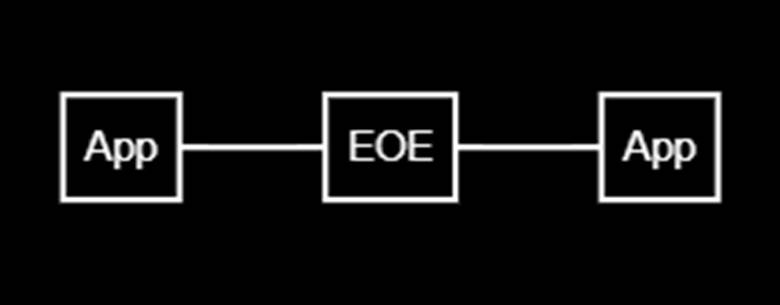
An EOE can provide an integration layer between applications. Rather than communicating directly with each other using proprietary endpoint details and JSON formats, the EOE abstracts the interface and allows the organization to use normalized JSON. There could be any number of apps connected to the EOE in this diagram.
Bridge
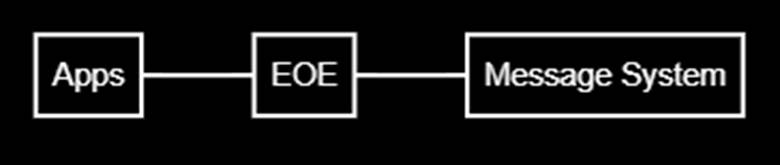
Similar to integration, but a bit more focused, an EOE can serve as a bridge between foundational systems such as enterprise message buses. Applications communicate with the infrastructure system through the EOE, avoiding proprietary interfaces while enabling service-oriented capabilities around that system.
Platform
An EOE can serve as a platform form enterprise solutions. The most common example is a digital experience management solution, which typically consists of at least a website that accesses multiple backend systems. For performance and specific capabilities, the application server or browser may access search and content management (especially its CDN that hosts media, which generally doesn’t require orchestration at runtime) directly, but most data flows through the EOE. In this case, the EOE functions as a backend-for-frontend (BFF).
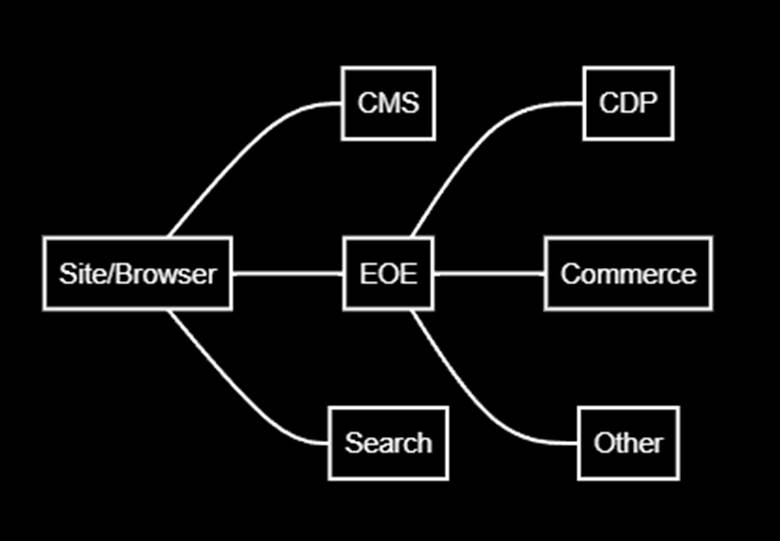
Below is another visualization of a similar solution architecture. The following diagram includes and omits some optional connections. For example, if the CMS or search vendor provide some kind of prebuilt integration, it may be preferable to use that instead of the EOE, so there is a line between search and CMS. At the same time, if there are good site generation tools or other features that depend on it, a direct connection between something in the CDN and the CMS may be appropriate, though this line is not shown.

 deliverystack.net
One thought on “-What Are Some Enterprise Orchestration Engine Usage Scenarios?”