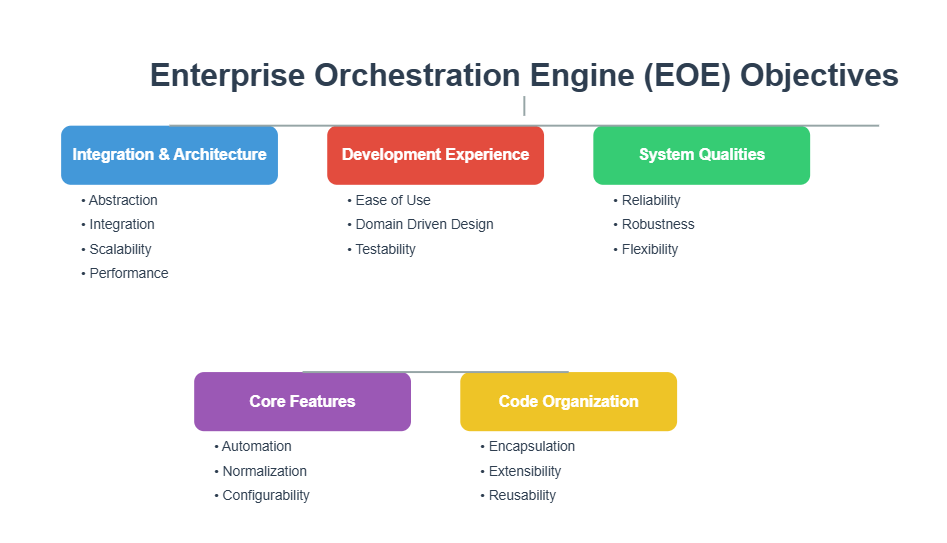
This blog post lists objectives of an Enterprise Orchestration Engine (EOE) such as Orchex.
Update 15.Dec.2025: After years of frustration with WordPress, I am finally abandoning this blog. The content will likely stay here for some time, but new content will appear here:
Before proceeding, see:
Objectives of the Orchex Enterprise Orchestration Engine (EOE) include, but are not limited to:
- Abstraction: One of the primary objectives of an EOE is to abstract systems. Regardless of the implementation details of the underlying applications, consumers invoke orchestration processes, which have a consistent programming interface controlled by the organization, not the individual system vendors.
- Automation: Orchestration automates processes.
- Configurability: To support the wide range of service-oriented applications, customer requirements, underlying storage mechanisms, and other variables including development, various forms of test, and production environments, the EOE must be highly configurable, beyond the ability to implement customer orchestration flows.
- Domain Driven Design: Rather than focusing on the particulars and specifics of individual vendor implementations, an EOE allows organizations to pursue domain-driven design and adapt the implementation to requirements to work with specific vendors.
- Ease of Use: The EOE should be compelling for developers to use, increasing their productivity, satisfaction, and the quality of their output.
- Encapsulation: Orchestration processes encapsulate business logic into reusable components.
- Extensibility: The EOE is extensible in that third parties can deliver custom solutions built with the EOE as a foundation.
- Flexibility: The architecture and codebase of the EOE must be flexible enough to accommodate emerging requirements, as technology shifts constantly.
- Insulation: The EOE insulates connected systems from each other. Rather than connecting to other applications directly through proprietary webservice API interfaces and JSON formats, the EOE insulates consumers from these implementation details.
- Integration: A primary goal of an EOE is to integrate service-oriented applications into composable solutions.
- Normalization: A major objective of the EOE is to normalize JSON, both on the way into the EOE and on the way out, so that customer applications do not work with vendors-specific JSON formats that customers cannot control and which lead to tight-coupling between the customer’s solutions and the vendors’ products.
- Performance: Especially with tuned caching and proper network topology, an EOE should increase overall solution performance by reducing webservice API calls from clients to systems with greater latency.
- Reliability: As a core technology for the enterprise, the orchestration engine must be highly reliable.
- Reusability: Orchestration processors and hence orchestration processors are reusable, varying their functionality and output depending on their input payloads.
- Robustness: Working with the EOE should feel like working with professionally designed software.
- Scalability: The architecture of the EOE, including its implementation in Rust and the underlying data provider model, has potential for virtually unlimited scalability.
- Testability: Encapsulating logic into orchestration processors available via webservice APIs supports testability.
 deliverystack.net
2 thoughts on “-Orchex Enterprise Orchestration Engine Objectives”